You’ve picked your products, started imagining what your store could look like, and maybe spent a little too long choosing the perfect shade of green for your logo.
But before you start selling online, there’s a pretty important question to answer:
Where are your products coming from, and who’s going to ship them?
You have a few options: You could use dropshipping, where a supplier ships products directly to your customers. You could try print on demand, where products are printed with your designs as people order them. Or, you could buy wholesale, keeping stock ready to sell and ship.
Each works a little differently, and the best choice depends on what you’re selling, how much you want to spend upfront, and how involved you want to be.
Let’s look at how dropshipping, print on demand, and wholesale work, what each one costs, and what you should know before choosing.
Dropshipping, print on demand, and wholesale at a glance
Here’s a quick comparison before we get into the details.
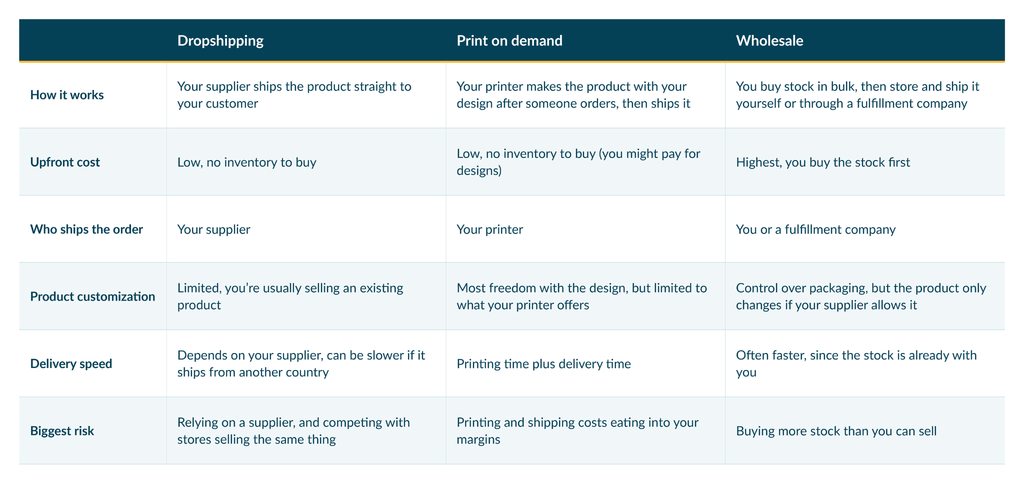
One thing worth mentioning: print on demand is technically a type of dropshipping. We’re looking at it separately because there’s an extra production step, and that changes a few things.
And when we talk about wholesale here, we mean buying products in bulk to resell through your store.
What is dropshipping and how does it work?
Say you want to sell running belts.
You find a dropshipping supplier that sells them, add the product to your online store, and start taking orders.
When someone buys a belt, your supplier packs and ships it directly to them. You never have to store the product or handle the parcel yourself.
Pretty convenient, especially if you’re starting out and don’t want to spend money on a hundred belts before knowing whether anyone will buy them.
But there’s a catch…
You’re trusting someone else to send the right product. In good condition. And on time. And if something goes wrong, it’s still your customer who’s going to email you.
That’s why I’d order a sample before selling anything. Try the belt yourself. Does your phone fit? Is the zip decent? Does it stay put when you run?
And take a good look at the competition. If five other stores are selling the exact same belt, what makes yours worth buying?
Sometimes it’s as simple as having better photos, a genuinely useful size guide, or product descriptions that answer questions people are actually asking.
Dropshipping could be a good fit if you want to test products without investing in inventory, and you’re comfortable relying on a supplier to fulfill your orders.
What is print on demand and how does it work?
Now imagine you want to sell T-shirts with your own illustrations printed on them.
Instead of ordering fifty shirts and hoping you’ve guessed the right sizes, you work with a print on demand (POD) company.
You upload your designs, choose the products you want to sell, and list them on your store.
When someone places an order, your printer adds the design to the product and ships it to your customer. You only pay to make the product when someone places an order.
The exciting part is that you can create something that’s completely your own without having to buy piles of inventory.
But not every printer offers the same products, colors, or printing options.
Maybe you’ve designed a beautiful floral illustration that runs down the sleeve of a shirt, only to discover your printer can’t actually print there.
A little annoying after spending three hours getting it just right.
So before you get too attached to an idea, check what your printer can or can’t do.
And always order a sample! You’ll want to see how the colors look, how the shirt fits, and whether the design survives a few washes.
Print on demand could be a good fit if you want to sell your own designs on products like clothing, mugs, posters, or accessories without buying inventory upfront.
Already getting orders? Our guide to scaling a print-on-demand business can help you figure out what to do next.
What is wholesale and how does it work?
Wholesale works a little differently because you’re buying products before anyone orders them.
Let’s say you buy 100 running belts from a supplier at a discounted price.
You now own those belts. You can store them in your garage, keep them in a warehouse, or pay a fulfillment company (sometimes called a 3PL) to store and ship them for you.
When a customer orders, one of those belts gets packaged and shipped.
The benefit? You have more control over your stock, packaging, and how quickly orders are prepared.
You could add a handwritten thank-you card, use your own branded packaging, or inspect products before they go out.
But the financial risk is also much higher.
If you buy 100 belts and only sell 20, you’ve still got 80 belts sitting somewhere, and money tied up in products you haven’t sold. So while buying in bulk can make each product cheaper, that doesn’t automatically make it the better deal.
Before placing a big order, ask your supplier about minimum order quantities (MOQs), shipping costs, and whether you can start with a smaller batch.
Wholesale could be a good fit if you already know there’s demand for your products, have money to invest in stock, and want more control over fulfillment.
Which model costs less to start?
If you’re working with a small budget, dropshipping and print on demand are generally easier to get started with.
You don’t need to buy inventory before making your first sale.
But that doesn’t mean starting is free.
You’ll still have startup costs like your online store subscription, product samples, transaction fees, and marketing. If you’re selling POD products, you might also need to pay someone to create your designs.
And watch out for the extras.
A T-shirt might look affordable until you add printing on both sides, a custom label, and shipping. Suddenly, the price you planned to charge leaves you with hardly any profit.
With wholesale, your biggest upfront expense is usually the stock itself. But you’ll also need to account for getting it delivered, storing it, and shipping individual orders to customers.
Then there’s also the forgotten cost of paying your supplier.
For example, with a connected Printful store, your customer pays you when they order, but Printful charges you to produce and ship the product. Depending on your payment provider, that customer’s money might not reach your bank account for a few days.
So even though you’ve made a sale, you’ll still need enough money available to pay for fulfillment. Double-check how payments work before your first order comes in.
Dropshipping vs. print on demand vs. wholesale: which is more profitable?
This is where things get interesting.
It’s tempting to look at what a product costs and what you can sell it for, then assume the difference is your profit.
But there’s usually a little more to it.
Say you sell a product for $30.
You’ve made a $30 sale, but only have $3 left before accounting for your other business expenses.
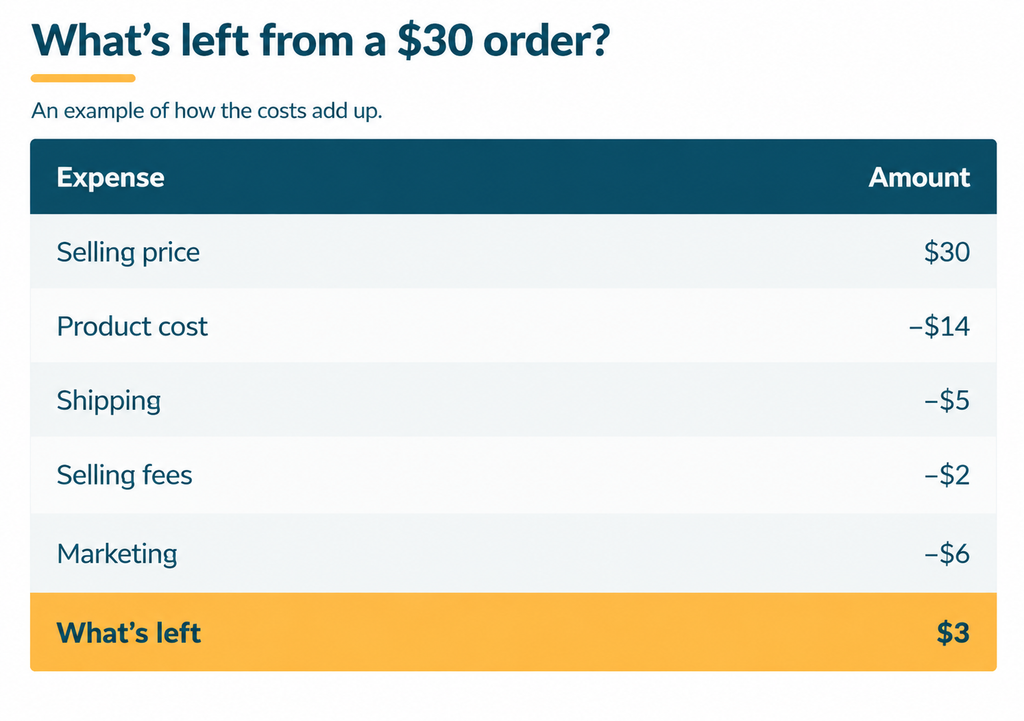
These are just example numbers, but you can see how quickly the costs add up.
And each business model has its own things to consider.
With dropshipping, you’re often competing with other stores selling similar products. That can make it harder to charge more unless you’re giving customers a good reason to choose you.
With print on demand, your designs can help your products stand out. But printing and shipping costs can eat into your profit margins, especially if you’re selling lower-priced items.
With wholesale, you could pay less per product because you’re buying in bulk. The risk is buying more than you can sell.
So which one makes the most money?
There’s no guaranteed winner.
A product with a great margin isn’t much use if nobody buys it. And making lots of sales doesn’t mean much if you’re barely keeping any money.
Before choosing a model, work out what you’ll actually earn from one order after all the costs you can reasonably estimate.
Product customization and packaging: how much can you change?
If building a recognizable brand matters to you, then you need to know how much freedom your supplier gives you.
With dropshipping, you’re usually selling an existing product. Some suppliers offer branded packaging or custom inserts, but others will ship everything in their standard packaging.
Print on demand gives you way more creative freedom with the design itself. You can put your artwork on clothing, accessories, home decor, and plenty of other products.
Just remember that you’re still limited by what your printer offers.
Wholesale gives you more control over how orders are packed, especially if you’re doing it yourself. You can choose the wrapping, add a handwritten note, or include a little extra surprise.
But buying wholesale doesn’t automatically mean you can change the actual product. That depends on what your supplier allows.
If packaging is a big part of the experience you want to create, ask about your options early.
There’s no point ordering 500 branded stickers only to find out your fulfillment partner can’t put them in the parcels.
Which model gets orders to customers faster?
Nobody enjoys waiting three weeks for something they thought would arrive in five days.
And as the store owner, you’re probably going to be the one answering those “where’s my order?” emails.
So shipping times are worth paying attention to.
With dropshipping, the product is usually ready to ship, but it might be coming from another country. That can mean longer delivery times.
With print on demand, your printer needs time to make the product before shipping it. If printing takes four days and delivery takes another two, your customer is waiting six days, not two.
With wholesale, you already have the stock, so orders can often go out faster. Of course, that depends on how quickly you or your fulfillment partner can pack and ship them.
Before promising delivery dates, check how long your supplier takes to prepare orders, where they ship from, and whether things slow down during busy periods.
Even better, place a test order and see how long it actually takes.
What work will you still need to do?
Whichever model you choose, you’re still running a business.
You’ll have customers asking questions, orders to keep track of, and the occasional delivery that doesn’t quite go as planned.
The difference is where you’ll spend most of your time.
With dropshipping, you’ll be checking supplier stock, following up on orders, and sorting out delivery problems.
With print on demand, you’ll also need to make sure the right designs, sizes, and printing details reach your printer.
And with wholesale, you’ll be keeping track of inventory, deciding when to reorder, and arranging packing and shipping.
Then there’s the less exciting stuff…
What happens when a customer receives the wrong item? Who pays if something arrives damaged? And how do returns work?
Ask your suppliers these questions before you start selling. You’ll be glad you did when your first unhappy customer emails you.
You’ll also want a reliable way to track orders and receive shipping updates, so you’re not chasing four different suppliers every time someone asks where their parcel is.
Can you combine dropshipping, print on demand, and wholesale?
Absolutely! You don’t have to choose just one.
You could buy running belts wholesale, dropship water bottles, and sell illustrated T-shirts through a POD company, all through the same online store.
The tricky part comes when someone orders products from more than one supplier.
Say a customer buys a running belt and a T-shirt together. The belt is sitting in your warehouse, while the shirt needs to be printed somewhere else.
You’ve received one order, but now you have two different places that need to fulfill it.
Your printer needs the right shirt size, color, and artwork. Whoever ships your belts needs to know which belt to pack. And your customer needs to know their items might arrive in separate parcels.
Otherwise, they’re going to open that first package, wonder where the rest of their order is, and send a very frustrated email to you.
This is where an order management tool like Order Desk can help.
With the right integrations and rules set up, you can split an order and send the right products and details to each fulfillment partner.
If you’re working with multiple suppliers, take a look at our integrations to see which partners you can connect. You can also read our print-on-demand fulfillment walkthrough to learn how to set up print details and split orders.
So, which model fits you?
It really comes down to what you want to sell, how much you’re comfortable spending, and how hands-on you want to be.
If you want to try selling products without buying inventory upfront, dropshipping could be a good place to start.
If you’ve got your own designs and want to turn them into products, print on demand gives you the freedom to create without having to predict how much stock you’ll need.
And if you’ve found products you know people want, and you’re ready to invest in inventory, wholesale might make more sense.
You don’t need to have everything figured out on day one.
Start with one product. Order a sample, work out your costs, and place a test order through your store. See how everything works before adding another twenty products to your catalog.
And if you’re still unsure which route to take, come chat with us in the Order Desk community group. There are plenty of store owners who’ve been through the same decisions and can share what they’ve learned.
Quick answers
Is print on demand the same as dropshipping?
Almost. Print on demand is technically a type of dropshipping, but there’s an extra step where your printer makes the product after someone orders it. That changes delivery times and costs.
Which is better for beginners, dropshipping or print on demand?
Both let you start without buying inventory. Dropshipping suits you if you want to test existing products, and print on demand suits you if you’ve got your own designs.
Is dropshipping or wholesale more profitable?
There’s no guaranteed winner. Wholesale can cost less per product, but you’re carrying the risk of stock that doesn’t sell. Work out what you’d keep from one order after costs before you decide.